Post-Booking Support: From Deflection to Resolution
AGODA | Global Head of Product Design, Agoda
Timeline: 2025 – 2026
Team: 2 product designers + Senior Design Manager
My Role
My role on VIVR was to set the strategic design direction and make sure the team had the clarity, resources, and executive air cover to build it well. The day-to-day design work was led by a strong design lead — my job was to frame the strategic tension correctly and hold the line on it. There was consistent pressure to optimise VIVR purely for deflection: flows that pushed customers away from agents as efficiently as possible. I pushed back on that framing and set the direction that VIVR should be designed to help customers resolve issues faster and more easily — deflection would follow as a consequence, not a target in itself.
Leadership
Cross-Functional Alignment
Air Cover
Team Setup
The Opportunity & Strategic Approach
A rising operational cost
Every date change, cancellation, payment question, or room issue that couldn't be self-served became a call or message — a large, growing Customer Experience Group cost that a better-designed product could absorb.
A digital phone tree, not a product
VIVR existed before this initiative, but it felt like what it was: rigid menu structures, generic options with no awareness of the customer's actual booking, and no conversational intelligence.
Double effort, not deflection
40% of users dropped off before selecting an intent and a further 51–56% picked the wrong one. Customers who tried to self-serve and failed simply called in anyway — creating work twice over.
Behind the category on usability
A GUIDE-framework audit benchmarked Agoda against Trip.com and found Agoda behind on structured inputs, recovery paths, and status visibility — the fundamentals of a trustworthy self-service flow.
Deflection vs. resolution
The business wanted lower contact volume. Customers wanted their problem solved. The opportunity was to design a product where those became the same outcome, rather than a trade-off.
A flagship bet for CEG
VIVR became the centrepiece of the Consumer Experience Group's post-booking roadmap — the flow every future self-service pattern would be benchmarked against.

Building a specialist design practice for a category no one had owned.
VIVR needed conversational design and service-design thinking that went beyond typical product UI work — so I structured the team, and my own involvement, around that.
Team Setup
Appointed a design lead with strong systems thinking and conversational-design capability to own day-to-day execution, with my focus on milestones, quality, and strategic alignment.
Frontline Partnership
Built close collaboration with CEG agents — the people who knew exactly which questions customers asked most, which policies caused confusion, and where existing flows broke down.
Operating Rhythm
Set up a regular audit and iteration cadence: the team reviewed real conversation transcripts and drop-off data, and redesigned the highest-failure flows first.
The Design Strategy & Key Decisions
Make the menu feel intelligent, not scripted
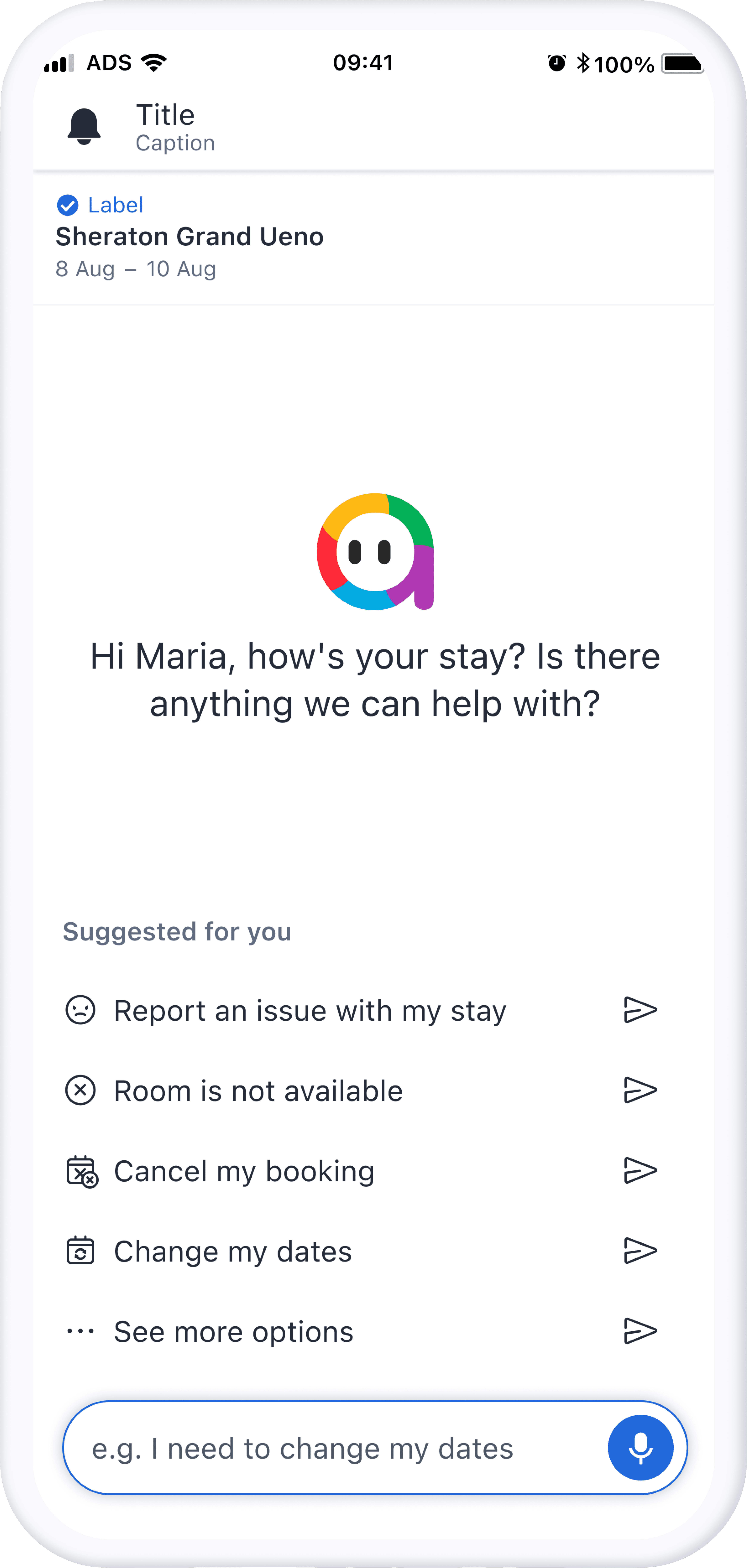
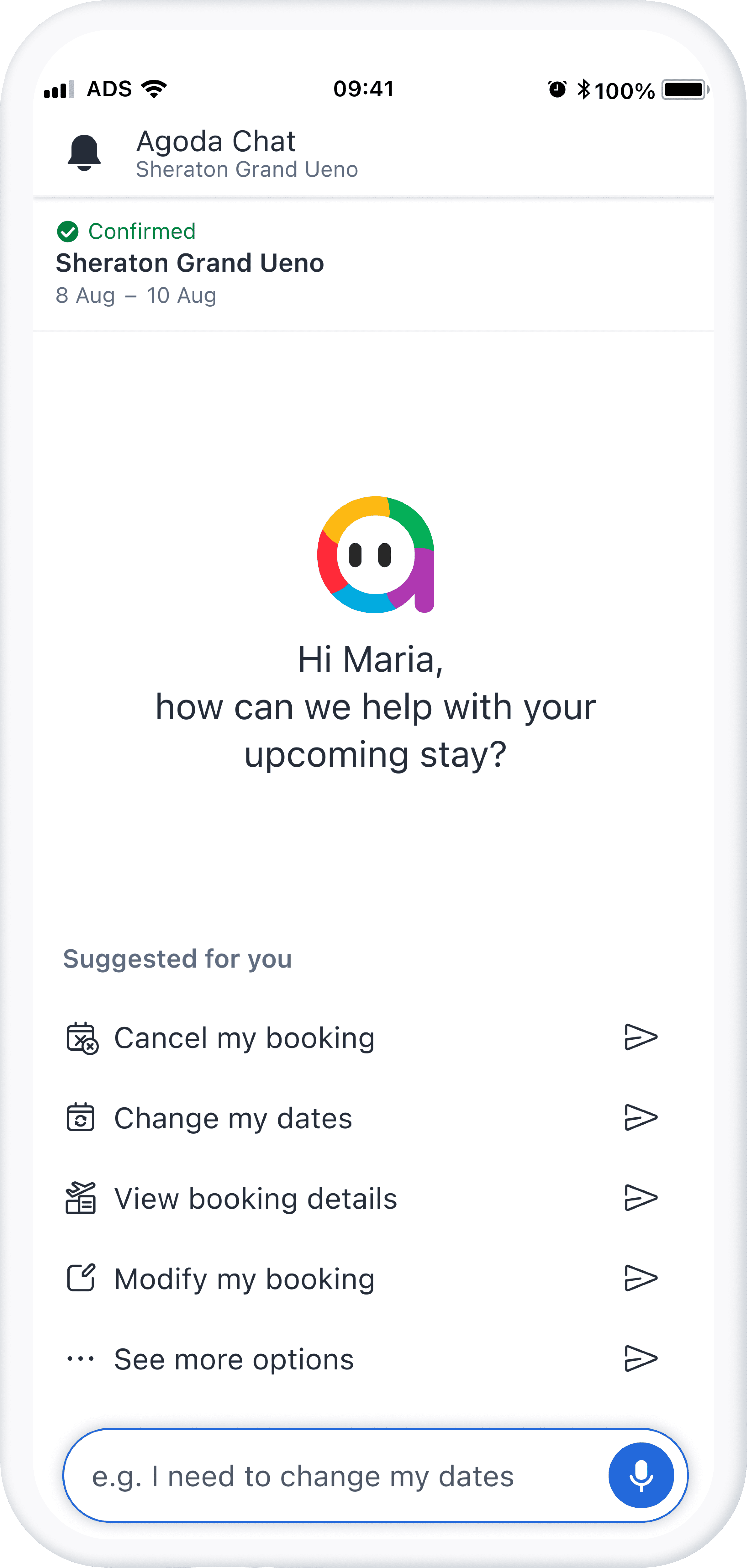
Every customer used to see the same menu, regardless of booking status. We rebuilt it to be contextually personalised — the greeting and suggested options now shift depending on whether the booking is confirmed, the guest is currently staying, or the stay has completed.
Design for resolution, not just deflection
Every flow was built around one question: what does the customer need to see to consider this resolved? For guests with more than one active booking, VIVR surfaces every open request and its live status up front, so nothing gets lost across bookings.
Close the loop, don't wait to be asked
Rather than waiting for customers to chase updates, approvals are pushed straight into the conversation and reflected immediately in the booking details — updated dates, status, and a downloadable confirmation, without a single follow-up message needed.
Improving the Main Menu
Problem
40% drop off. 56% enter wrong flow. No hierarchy, no ranking, no correction path.
Strategic Focus
Personalise and rank options using booking context. Reduce choices. Give users a way to correct course.
Outcomes
Personalise and rank options using booking context. Reduce choices. Give users a way to correct course.


Scalability to other languages
Problem
We have a global product, we need to scale to other languages to accommodate customers needs
Strategic Focus
Build a scalable UX solution that can accommodate other languages and still have a uniformed working UX
Outcomes
Personalise and rank options using booking context. Reduce choices. Give users a way to correct course.


Provide clarity & visibility on solutions & progress to ease anxiety
Problem
User were often anxious in our current customer support bot, as there were was no real time updates.
Strategic Focus
Provide clarity, and real time updates to help reduce customers calling our agents & reducing our handle time cost.
Outcomes
Personalise and rank options using booking context. Reduce choices. Give users a way to correct course.


Provide timely updates
Problem
User often had to call the hotel or our agents to confirm there request status and ended up increasing our cost.
Strategic Focus
We solved this by creating real time updates via sms, text & email for our . users to avoid anxiety calls to our agents.
Outcomes
Personalise and rank options using booking context. Reduce choices. Give users a way to correct course.


The Outcome & Business Impact
The redesigned patterns were piloted on the Self-Service Fee Waiver flow before being scaled across VIVR — validating the approach with real usage data first.
65→94%
SSFW completion rate
Jump in pilot flow completion after replacing sequential chat with a single structured form and a visible status tracker.
+13.4%
Self-service completion rate
Uplift across flows once the redesigned patterns shipped beyond the pilot.
−3.32%
Touch booking rate
Fewer bookings requiring an agent touch after self-service — resolution replacing escalation.
"When customers stop calling because the digital experience actually solved their problem — that's the most honest measure of design success."
How we got there
From rigid menus to context-aware entry
The GUIDE audit showed users had no hierarchy, ranking, or correction path at the main menu. Personalising options by booking context and reducing visible choices fixed the single biggest source of drop-off.
Forms over one-message-at-a-time chat
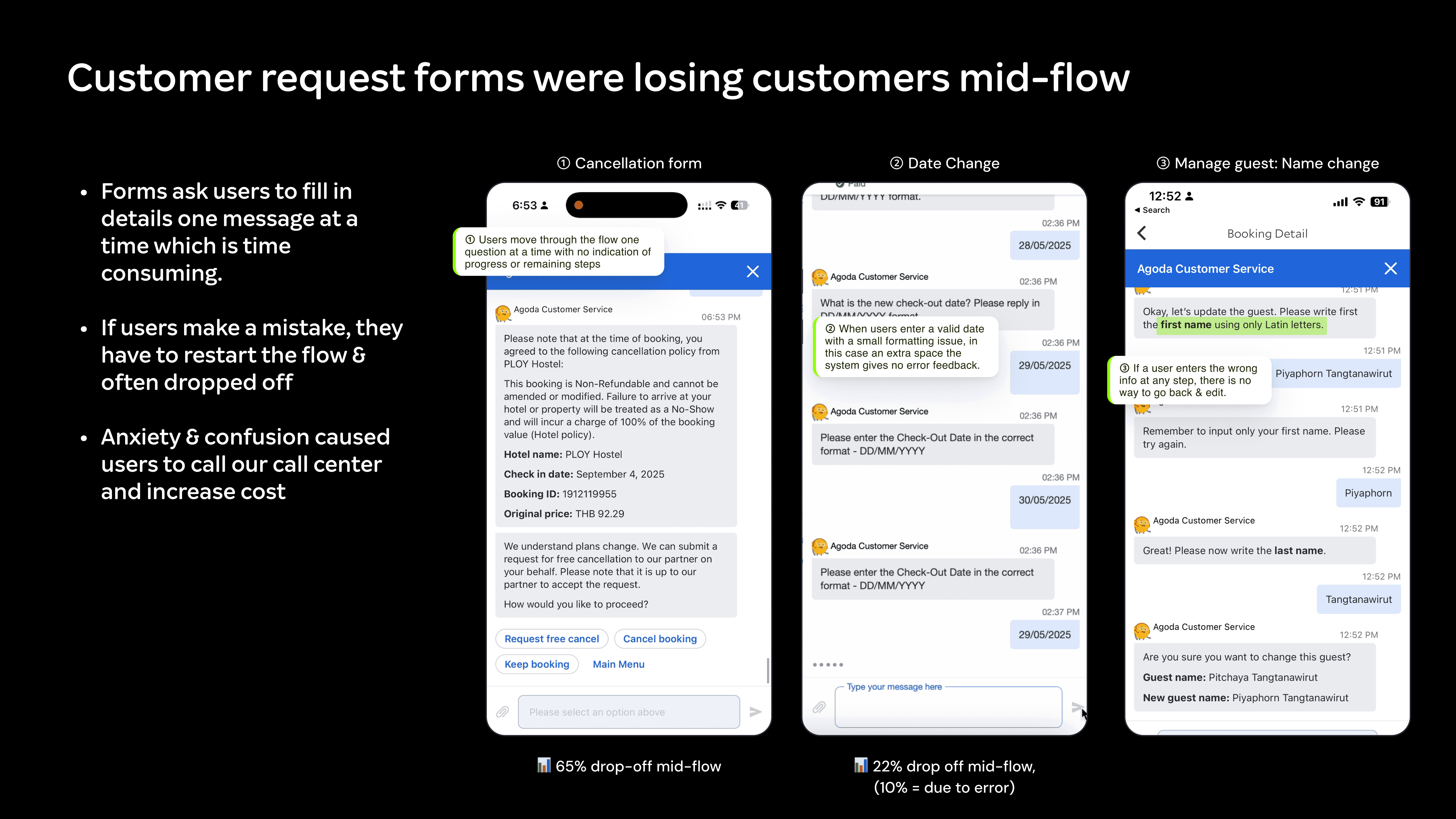
Sequential chat forced a restart on every mistake, driving 62.7% mid-flow abandonment. A single scalable form component — reused across cancellations, date changes, and name changes — let users edit freely before submitting.
Visibility at every stage
Status trackers and reassurance notifications replaced silence after submission, cutting the anxiety-driven follow-up contacts that came from customers not knowing if their request had gone through.
A clean handover between bot and human
Before handover, VIVR now summarises the issue and booking context so customers stop repeating themselves — and updated headers and avatars make it unmistakable once a human agent has joined.
Rich media over walls of text
Cards, tables, timelines, and maps replaced dense paragraphs for policy details, refund timelines, and location information — making complex answers scannable instead of buried.
Prove it small before scaling it wide
Every pattern was validated on the SSFW pilot flow first. Once completion moved from 65% to 94%, the same patterns were rolled out to date changes, special requests, and manage-guest flows.
Glimpse of Outputs